
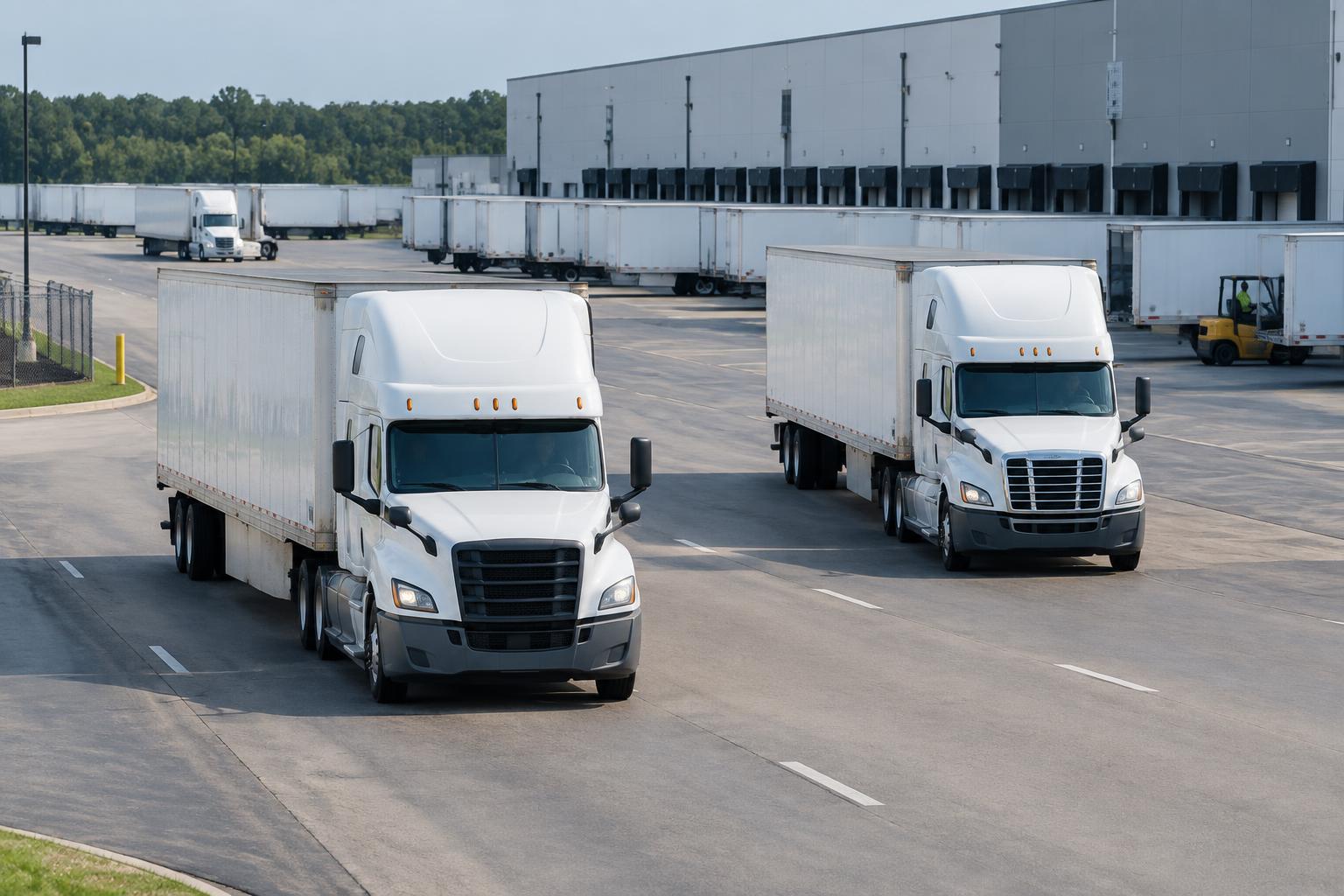
Reporting and analysis by the SHOD Express Editorial Team. October 6, 2026. Headline image: an original AI-generated illustration of a freight yard, not a photograph of either company’s operations.
A merger announcement does not put another load on a truck. But C.H. Robinson’s agreement to acquire RXO would change who controls a substantial network of freight, carrier relationships and shipping customers. For an owner-operator, the practical question is not the purchase price. It is whether the combined business makes loads easier to find, changes negotiating leverage, or complicates getting paid during integration.
On Monday, October 5, C.H. Robinson and RXO announced a definitive agreement for a transaction with an implied value of approximately $5.8 billion. The companies expect the deal to close in the first half of 2027, subject to regulatory approval, RXO shareholder approval and other customary conditions. As of this article’s publication, this is an agreed acquisition—not a completed merger.
The numbers, without the confusion
The standard payment to RXO shareholders is $17.25 in cash plus 0.0856 shares of C.H. Robinson stock for each RXO share. The exchange ratio is 0.0856, not the 0.0909 figure in the supplied brief.
The companies put the implied consideration at $30.25 per RXO share, using C.H. Robinson’s 16-day volume-weighted average share price of $151.88 as of October 2. That valuation basis matters: the stock component should not be described as a fixed cash payout.
Shareholders may elect all cash at $30.25 per share, or all stock at 0.1992 C.H. Robinson shares. Those elections are subject to proration and adjustment to maintain the agreed overall cash-and-stock mix. An all-cash election is therefore not an unconditional promise that every holder will receive only cash.
What the $300 million target actually means
C.H. Robinson expects approximately $300 million in annual net run-rate cost synergies within two years after closing. In plain terms, that is the annual savings pace the company hopes to reach—not $300 million already saved, and not a guaranteed benefit to truck drivers.
The announcement identifies operating efficiencies, shared services, third-party spending and lower costs to serve customers as sources of savings. It also proposes applying C.H. Robinson’s Lean AI operating model to RXO and combining larger datasets for sales, freight matching and procurement.
Those are management’s expectations. Execution still has to follow: integrating systems, retaining customers and employees, and keeping service reliable while the businesses change. A cheaper transaction for a broker does not automatically mean a higher rate for a carrier or a lower invoice for a shipper.
RXO’s Coyote purchase explains the scale
RXO is not coming into this transaction with its original network alone. It completed its acquisition of Coyote Logistics from UPS on September 16, 2024, for $1.025 billion. RXO said that purchase made it the third-largest provider of brokered transportation in North America.
The proposed C.H. Robinson transaction would bring that expanded network into another major brokerage. Its announced value is substantially larger than the Coyote purchase, although the two transactions should not be treated as identical valuation measures. What matters operationally is the combination of customer accounts, freight volumes and carrier relationships—not just the headline comparison.
For carriers: more freight access, but fewer separate relationships
A denser network could help a carrier find a reload closer to its delivery point. That would be useful if it reduces empty miles or waiting time. The companies describe better network density as a strategic benefit, but they have not guaranteed fewer deadhead miles or better carrier pay.
The other side is concentration. A carrier that currently works with both businesses could eventually have fewer independent large-broker relationships. That may affect bargaining options on particular lanes. It does not establish that rates will fall nationwide: freight demand, available trucks, geography and service requirements still matter.
During any integration, the details worth watching are ordinary ones:
- Which load board, account and carrier onboarding process applies.
- Whether existing contacts and escalation channels change.
- Payment timing, quick-pay fees and the legal entity named on the rate confirmation.
- Detention, layover, cancellation and accessorial terms.
- Whether an attractive load still works after empty miles and unpaid time are included.
These are watch points, not announced changes to either company’s carrier policies. Carriers should rely on written instructions from the companies rather than assume accounts or payment processes have already merged.
For other brokers: scale is a challenge, not the whole business
A combined platform could spread technology investment over more shipments and offer shippers a wider mix of services. The announcement specifically brings together brokerage and managed transportation, C.H. Robinson’s global forwarding, and RXO’s expedited and last-mile capabilities.
That creates a competitive challenge for brokers whose pitch is simply access to capacity. Smaller firms may have a stronger case where they know a difficult lane, handle specialized freight, solve an urgent problem or provide a consistent person who answers the phone.
This is analysis, not a prediction that independent brokers will disappear. Freight remains operationally messy. A large network does not by itself settle a detention dispute, prevent a missed appointment or build trust with a carrier.
What happens next
The next milestones are approvals, closing and the actual integration plan. C.H. Robinson says it intends to integrate RXO primarily into its North American Surface Transportation division after completion.
Until then, the useful distinction is between the deal’s stated ambition and its demonstrated results. The purchase price is announced. The savings are a target. Changes to carrier economics will need evidence from rates, terms, payments and service—not a press-release promise.
For a trucking business, the sensible response is to keep a diverse customer and broker base, check the all-mile economics of each load and watch official updates. A bigger brokerage network may create opportunities. It does not replace the discipline of knowing what a load costs to haul.
Sources and editorial note
- C.H. Robinson and RXO joint announcement, October 5, 2026 — transaction value, shareholder consideration, synergy target and expected closing conditions.
- RXO publication of the acquisition announcement — the target company’s statement of the proposed transaction.
- RXO completes its Coyote Logistics acquisition, September 16, 2024 — purchase price and RXO’s stated market position following that acquisition.
Prepared from an editorial brief supplied to SHOD Express. Transaction details were checked against the companies’ original announcements. Discussion of possible effects on carriers and competing brokers is SHOD’s analysis, not an announced policy, investment recommendation or earnings guarantee.