
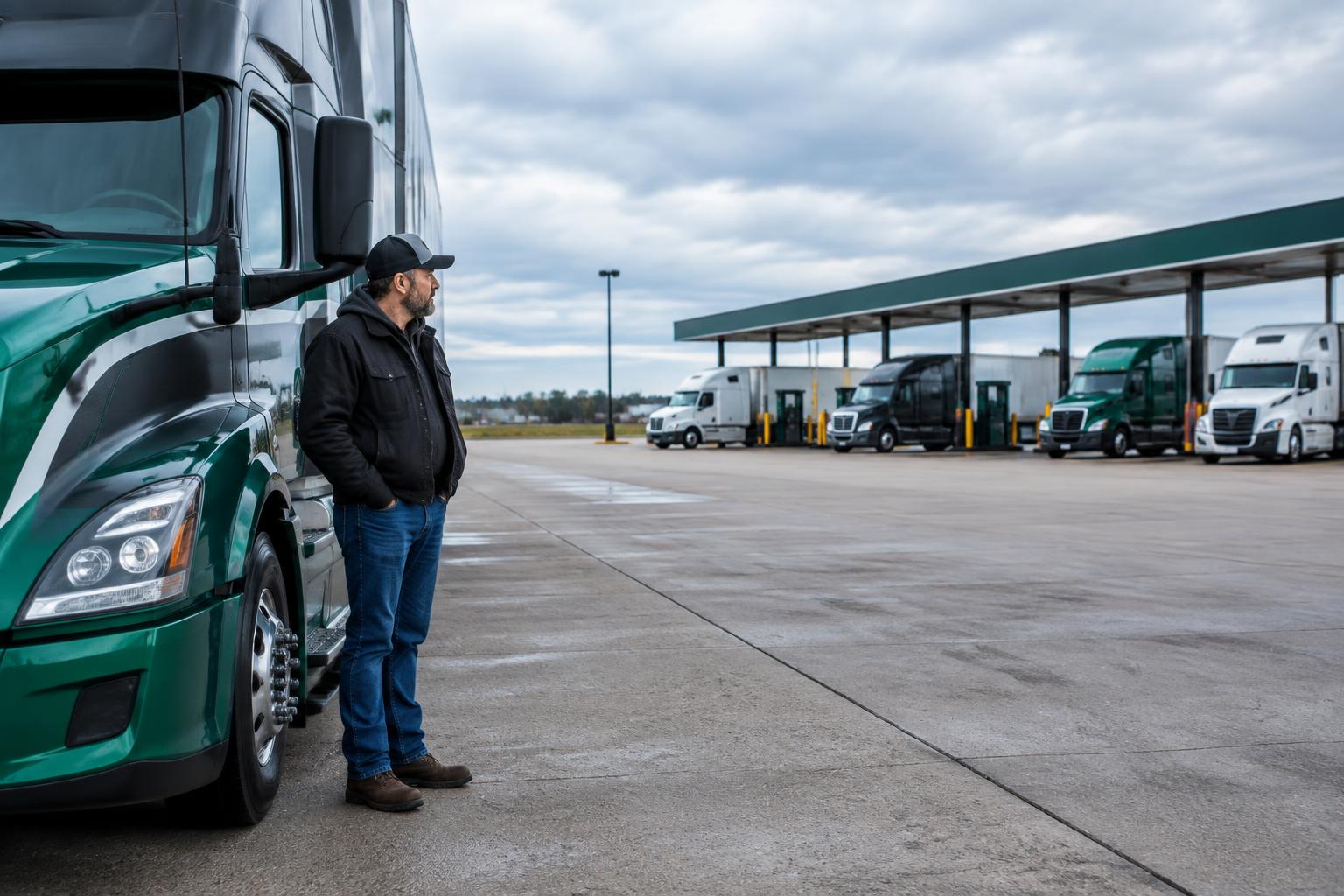
A nationwide truck shutdown was not confirmed for October 1, 2026. The Owner-Operator Independent Drivers Association (OOIDA) said it was not organizing one, and described the talk as social-media chatter rather than a coordinated action.
That does not mean the frustration is imaginary. The more useful question is not whether every truck will stop on one date. It is why the idea found an audience among independent drivers in the first place.
Diesel is taking a larger bite out of every loaded mile
The U.S. Energy Information Administration reported a national on-highway diesel average of $6.382 per gallon for the week ending September 28, 2026.
Consider a simple 1,000-mile example. A truck averaging 7 miles per gallon would burn about 143 gallons. At $6.382 per gallon, the fuel bill would be approximately $912.
That is an operating-cost example, not an earnings estimate. Actual fuel use changes with the truck, load, route, terrain, weather, idling, and driving style.
A strong rate can still produce a thin margin
Suppose an owner-operator books a hypothetical load at $3.00 per loaded mile. Fuel at roughly $0.91 per mile would consume about 30% of that gross revenue before the carrier pays for anything else.
The remaining revenue still has to cover costs such as:
- Insurance
- Maintenance and unexpected repairs
- Truck and trailer payments
- Tolls, permits, and compliance
- Deadhead miles between loads
- Time lost waiting at shippers and receivers
- Taxes and the driver’s own pay
A posted freight rate therefore does not tell the whole story. What matters is the margin left after every loaded and empty mile is counted.
Why owner-operators feel the pressure first
Company drivers normally do not buy the truck’s diesel directly. Independent owner-operators do. When pump prices rise faster than freight rates or fuel surcharges, the change reaches their weekly cash flow immediately.
Small carriers also make up a large share of the industry. Federal carrier data consistently show that trucking is dominated by small operations, but we have left out an unverified statistic circulated in the source draft rather than repeat a precise percentage without a dependable original source.
This distinction matters. The current discussion is not evidence that all truck drivers share one plan. It is evidence that many small operators are closely watching whether the loads available to them can cover the cost of running their equipment.
Why fuel surcharges do not solve every problem
A fuel surcharge can help, but it does not automatically protect a carrier’s margin. The formula may be delayed, may apply only to loaded miles, or may not fully reflect the driver’s actual fuel price.
A carrier can also lose money on miles that never appear in the advertised rate. If a driver runs 150 empty miles to pick up a 1,000-mile load, the revenue must be spread across 1,150 total miles—not just the loaded portion.
That is why experienced operators watch revenue per all mile, not only the headline rate.
Is there a nationwide trucker strike?
As of October 1, 2026, there is no verified, centrally organized nationwide trucker strike. OOIDA has publicly said it did not call for or organize one. Individual drivers may still choose to park their trucks, reject unprofitable freight, or reduce operations, but those decisions are not the same as a coordinated national shutdown.
Claims that grocery shelves will immediately empty or that the entire country’s freight network will stop should be treated cautiously unless supported by current evidence. A meaningful supply-chain effect would require enough capacity to come out of service for long enough to disrupt freight movement.
What working drivers should watch
The daily decision is more practical than the rumor. Owner-operators should monitor:
- Local diesel prices, not only the national average
- Revenue per all mile after deadhead
- Fuel-surcharge terms and payment delays
- Maintenance reserves and insurance renewals
- Truck and trailer payments
- Load availability on the lanes they actually run
- The time required to load, unload, and reposition
For SHOD Express owner-operators, the current offer lists $12,000–$15,000 average weekly gross and a 12% dispatch fee. Average gross is not take-home pay, and no weekly result is guaranteed. Drivers should compare any offer against their own truck costs, route mix, and business obligations.
The honest answer
Drivers are talking about a strike because the economics of hauling freight have become harder to ignore. Diesel is expensive, operating costs remain high, and small carriers have less room to absorb a bad week.
The October 1 rumor was not a verified nationwide shutdown. The financial pressure that made the rumor believable is the real story.
Review SHOD Express owner-operator terms or apply to drive.
Sources and credit
This SHOD Express article was adapted from an article supplied by the Golden Touch Logistics Editorial Team. SHOD independently reviewed the underlying figures and reporting before publication.
- U.S. Energy Information Administration — Weekly U.S. on-highway diesel prices
- Land Line Media — Why doesn’t OOIDA call for a strike?
- Newsweek — Are Truckers Going on Strike October 1?
- Snopes — Is a nationwide truck-driver strike planned for Oct. 1?
Published by the SHOD Express Editorial Team on October 1, 2026. Cost and earnings examples are educational illustrations, not guarantees.